One Small Tribe
How a few thousand people, 70,000 years ago, became the ancestors of everyone outside Africa, and why every other kind of human disappeared.
Based on: Vyshedskiy, A. (2026). “How one small tribe conquered the world 70,000 years ago.”
Transcript
Show / hide
Everyone you will ever meet outside Africa descends from one small tribe. Not an empire. A tribe. A few thousand people, seventy thousand years ago.
They walked into a world full of other humans. Thirty thousand years later, every other kind of human was gone.
What did they have, that nobody else did?
Nobody wrote anything down back then. But everyone left a fingerprint. You are carrying it. The Y chromosome passes from father to son, unchanged except for the occasional typo. Follow the typos backward, and you get a tree.
Every lineage outside Africa, and half of those inside, traces back to one branch, called C T. Around seventy thousand years ago, that branch explodes. C, D, F, a whole thicket, spreading across Eurasia and Australia.
Now the mothers. Mitochondria, the tiny batteries in your cells, come only from mom. Same story. One branch, L three, and its daughters M and N, bursting outward at the same moment.
Two independent clocks, ticking in sync. And the paper adds three more. The whole genome: everyone outside Africa comes from one migration, seventy to fifty thousand years ago. A bottleneck: outside Africa, genetic diversity drops, like a river thinning through a narrow gate. And Neanderthal DNA. Everyone outside Africa carries about two percent.
Africans, almost none. So the tribe met the Neanderthals just past the exit, in the Levant, and kept walking.
Five fingerprints. One tribe. Genetics is sure about the who. It says nothing about the why.
Seventy thousand years ago, Earth was a neighborhood. Neanderthals in Europe and the Middle East. Denisovans across Asia. Homo erectus in the islands. And across Africa, many tribes of archaic Homo sapiens.
All had fire and tools. Most had been there for hundreds of thousands of years.
Then, in northeastern Africa, one tribe starts to grow. By sixty-five thousand years ago they are pushing out through the Levant, and spreading inside Africa too. By forty thousand years ago, outside Africa, nobody else is left.
And both the men and the women were replaced. That matters. Conquering armies kill the local men and take the women. That leaves old maternal lineages and young paternal ones. That signature is not there. Both clocks read seventy thousand.
Not an army. Families, walking.
Inside Africa the spread was slower, and never complete. Older lineages, like the San in the south, are still here.
So what was the advantage? Science has a lineup. Bigger social brains? Gradual, and shared by everyone. That cannot explain one tribe winning everywhere.
Better tools? The same hand axes had been around for a million years. Climate? This whole period sits inside one long, stable ice age. The Toba supervolcano? It erupted seventy-four thousand years ago and dimmed the planet.
But Neanderthals survived it for thirty thousand more years. Toba thinned the crowd. It did not clear the room. Speech? The throat, the ear, the hyoid bone were six hundred thousand years old.
Neanderthals had them too. Every suspect has an alibi. So whatever we are looking for is not in the throat, or the hands. It is behind the eyes.
The clue did not come from a cave. It came from children. Vyshedskiy's group studied language in over one hundred thousand children with neurodevelopmental conditions. Comprehension, it turns out, does not climb a smooth ramp. It settles onto one of three plateaus.
Room one, the Command Phenotype. Your name. No. Stop. Room two, the Modifier Phenotype. Big apple now differs from small apple.
Color, size, number. Room three, the Syntactic Phenotype. The cat ate the mouse is not the mouse ate the cat. Prepositions. Tenses. Stories.
Typical kids reach room one by two, room two by three, room three by four.
And there are no landings on this staircase. Nobody gets half of room three. One damaging mutation drops a child all the way back to room two, every ability at once. Syntax is one package.
So the paper's bet: seventy thousand years ago, one tribe stepped from room two into room three. And the world changed.
Can we see it in the dirt? Two places. Pictures. The oldest figurative painting is a warty pig in Sulawesi, forty-five thousand years old. Before seventy thousand: not one drawing, anywhere.
And graves. Burials with beads, ochre, and offerings bloom after seventy thousand years ago. You cannot believe in an afterlife without understanding a story. Only room three imagines what is not there.
But if the step is a package, how does it get taken the first time? Here is the catch. Syntax has a deadline. If a child is not exposed by about age five, the door closes. For life.
So picture a tribe where every adult lives in room two. Their children never hear a full sentence. The door closes. Generation after generation.
Unless a few children, raised together, invent it themselves. It has happened in our lifetime. Deaf children in Nicaragua, with no shared language, built a fully syntactic sign language in two generations. The paper names them after the founders of Rome, raised by a wolf who could not teach them to speak. Romulus, and Remus.
Two things had to line up. First, longer childhoods. That was slow. Genes like S R G A P two and M C P H one spent millions of years stretching childhood, as brains grew from three fifty, to thirteen fifty cubic centimeters.
Then, the spark. A few children, playing together, inventing on, and behind, and yesterday. Once it existed, it did not wait for genes. It spread like a story spreads. A cultural sweep, not a genetic one. Like lactose tolerance racing through dairy cultures, with a far bigger prize.
Plan a hunt. Set a trap. Lie to a rival. Hold a hundred people together with a tale. Against that, a bigger jaw does not help.
This is a synthesis: genetics, archaeology, and child development, stitched into one story. Stitches can come loose. The genetics says who spread. It cannot say what they were saying. The archaeology is thin: a few caves, a few hundred graves. Absence is a weak witness.
And many researchers argue the step was gradual, built over two hundred thousand years from pigments, shells, and scratches in southern Africa. The paper's reply: room two can make those. And the southern lineages are not the ones that spread. The argument is strong. It is not settled. That is what hypotheses are for.
Not just lion. Lion, behind the rock, tomorrow. Not just fire. Once upon a time, there was a fire. The weapon that conquered the world was imagination. And it was built by children, in play.
It still is. Every four-year-old re-crosses that threshold. Every bedtime story is seventy thousand years old. Somewhere tonight, a small person is telling a story about something that never happened. That is the tribe. Still walking.
So zoom out. Every human alive descends from, or was shaped by, a small group who learned to say things that were not true yet.
 One Small Tribe, cinematic cut
 The Closing Door
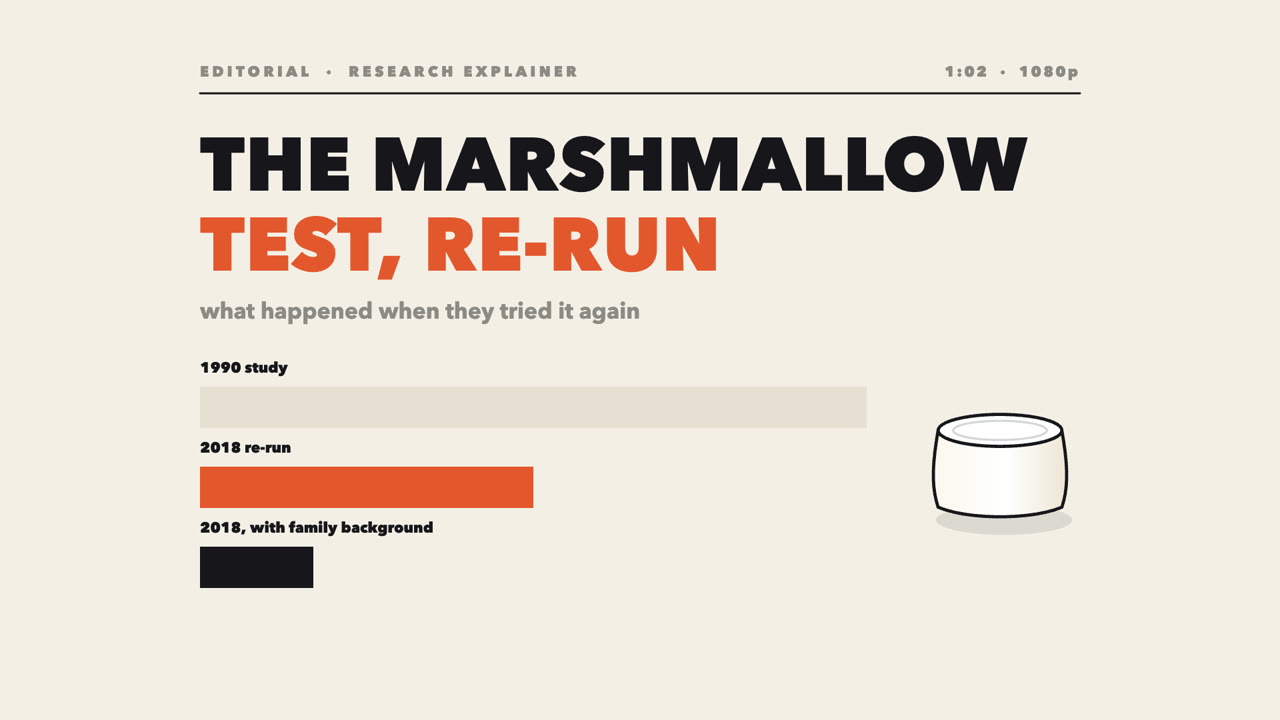 The Marshmallow Test, Re-run